A machine listing can name a pneumatic press and compressor without showing whether moulds, controls, hoses, filtration or drainage trays are actually included. By the end, you will have an item-by-item checklist for the package, the utility figures to request and the operating details needed to compare quotations accurately.
Key takeaways
- Demand an itemized list of press, moulds, controls, compressor and washing components.
- Match compressor delivery pressure and airflow to both pressing heads running together.
- Confirm food-contact materials, drainage and cleaning access before accepting the machine.
- Test paneer firmness, moisture and cycle time at the quoted pressure.
The complete package: press, moulds and air controls
An itemized supply list must identify every physical, pneumatic, electrical and washing-related component; “double head press” alone is incomplete. The paneer press machine specifications should also separate compressor power from pressing capacity.
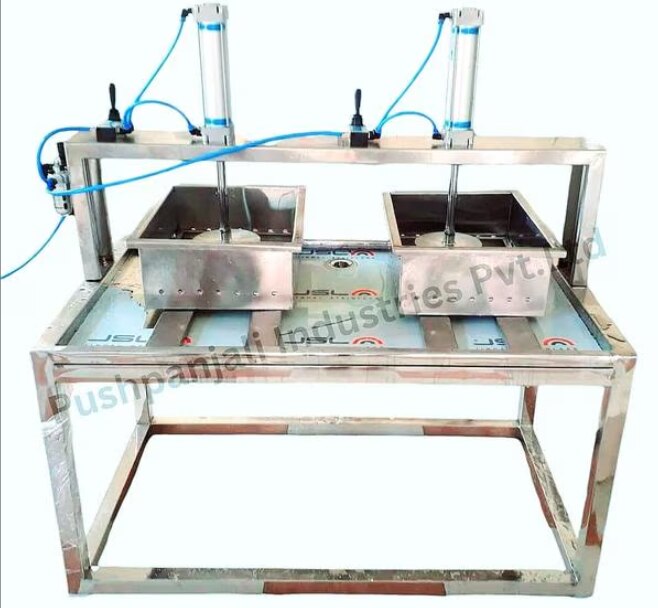
- Stainless-steel frame with two pressing cylinders or heads
- Two pressing platens, follower plates and mould supports
- Moulds, perforated drainage trays, liners or cheesecloth arrangement, and spare mould quantity
- FRL unit or filter-regulator, pressure gauge, directional control valves, tubing, hoses and fittings
- Control panel, start/stop controls, solenoid valves, wiring, isolator and guarding
- Compressor, only if explicitly included, with receiver, motor and electrical details
- Wash-water connection, drain arrangement and cleaning access
Check the quotation against this comparison before treating the package as complete.
| Item on quotation | What it means | What you must confirm |
|---|---|---|
| “50-litre compressor included” | A receiver size is stated, not the complete air specification | Motor power, delivered air flow, maximum pressure, voltage, phase, duty cycle, noise level and moisture separator |
| “Pneumatic press only” | The buyer supplies plant air and compressor equipment | Compressor, hoses, FRL, gauge, valves and fittings are excluded or separately priced |
| “Two moulds supplied” | One mould may serve each head, but tray capacity remains unclear | Mould dimensions, usable filling volume, perforated trays and spare quantity |
| “Complete machine” | A broad sales label, not an inventory | Control panel, electrical parts, guarding, installation and wash-down provisions |
Ask the supplier to mark each line as included, excluded or optional. A 5 HP figure is meaningless until it states whether it describes the compressor motor or another component.
How to verify the compressor and air supply
A 50-litre portable compressor is not automatically included with a double head paneer press with compressor. Confirm the inclusion on the quotation for the complete double-head package, not in a separate pneumatic-press listing. A 50-litre receiver describes stored air volume; it does not prove that the compressor can deliver enough air for two cylinders.
1. Ask for the compressor’s motor power, receiver capacity, maximum pressure, delivered flow, voltage, phase, duty cycle and noise level. Require delivered flow at the stated pressure, identified as free-air delivery (FAD); displacement figures make the compressor look larger than its usable output.
2. Check whether the offer includes a moisture separator or dryer, filter-regulator-lubricator (FRL) unit, pressure gauge, valve, hoses and fittings. Moisture entering the valves can cause sticking, while undersized tubing slows cylinder movement.
3. Request the press’s required inlet pressure and air consumption per cycle for one head. The compressor’s available flow must cover both heads operating together, plus leakage and cycling reserve.
4. Run a simultaneous-cycle test before accepting the specification. Watch for pressure dropping below the required inlet pressure, slow extension or retraction, and unequal platen movement; a compressor that handles one head can fail when both heads operate.
5. Confirm whether both heads share one regulator and valve or have separate pressure controls. A shared control may press both stations together but cannot provide independent settings unless the quotation lists separate regulators and gauges.
If the supplier will not state compressor inclusion, FAD, pressure and two-head air consumption in writing, treat the package as press-only and price a suitable plant-air system separately.
What double head means for force, cycle time and output
Two pressing heads normally mean two pneumatic cylinders or stations working in parallel, each pressing its own filled mould. They do not automatically mean two complete moulding lines, independent recipes or twice the hourly output.
| Arrangement | What happens | Throughput effect |
|---|---|---|
| Shared regulator and valve | Both heads receive the same pressure command | Simple control, but unequal loading or air demand can affect pressing |
| Separate pressure controls | Each head is adjusted independently | Better control when mould loads or products differ |
| Two moulds with one operator | The operator fills and loads both stations sequentially | The second head may wait, reducing the practical gain |
| Two complete loading and unloading paths | Both stations cycle without blocking each other | Output can approach two single-head cycles |
Compare paneer press machine specifications using batch weight, usable mould dimensions, number of moulds per head, cylinder bore and stroke, working pressure, maximum pressure and air consumption per cycle. Cylinder bore and pressure determine available force; stroke determines whether the follower plate reaches the product correctly.
Require the quoted cycle time to include pressing, release and mould changeover, not only cylinder extension. Ask for output per cycle, expected hourly throughput and the operator count used for that claim.
A shared compressor must supply both cylinders during simultaneous cycling, plus reserve for leakage; otherwise extension slows, pressure drops and the two batches finish unevenly.
The quotation should also state whether moulds, drainage trays and spare moulds support continuous loading while pressed product is removed. Without that capacity, the second head becomes idle equipment.
Materials, sanitation and the operating sequence
Food-contact parts should be identified by grade and finish, not described only as “stainless steel.” Specify SS 304 or SS 316 for the platen, moulds, perforated drainage trays and fasteners; SS 316 suits chloride-based cleaners and saline conditions better. Separate these parts from the structural frame in the quotation.
Smooth welds, rounded corners and removable moulds prevent curd from collecting in crevices. Each head needs a defined mould size, follower plate, cheesecloth or liner arrangement, drainage path and tray capacity. Missing drainage space leaves whey under the block and produces uneven moisture.
1. Wash the moulds, follower plates and trays with the approved detergent, rinse with potable water, and sanitise before loading. Remove curd from perforations; trapped residue can block drainage and contaminate the next batch.
2. Fit the liner evenly, place the curd into both moulds, and level the fill. An uneven fill gives different block density even when both cylinders use the same pressure.
3. Slide each mould onto its drainage tray and centre the follower plate beneath its pressing head. Check that the plate moves freely without touching the mould wall.
4. Pass compressed air through a filter and moisture separator before the regulator and control valve. Wet air causes sticking cylinders, corroded valves and erratic motion.
5. Set the regulator, confirm the gauge is readable across the working range, and run both heads for the specified press time. The system needs a pressure-holding or controlled-exhaust arrangement; a gauge alone cannot prove that both batches received the same pressing force.
6. Exhaust fully, remove the pressed blocks, and wash and sanitise every product-contact part before the next cycle.
Pressure settings, product testing and the quotation checklist
Do not copy the regulator number from another recipe. Applied pressure also depends on cylinder bore, stroke, platen area, mould geometry and load distribution. Start at the lowest setting that produces the required firmness, then record curd weight, pressing time, block thickness, moisture loss and texture.
| Product | Setting decision | Test result to accept |
|---|---|---|
| Paneer | Increase pressure gradually until the block holds its shape without a rubbery bite | Even thickness, clean cutting and controlled whey drainage |
| Tofu | Use gentler loading and extend the dwell time before increasing force | A cohesive block without crushed edges or excessive water loss |
| Cheese | Set pressure for the specific curd and target texture; do not copy paneer settings | Uniform body, correct moisture and no cracked surface |
Your quotation comparison should include:
- Cylinder bore and stroke, maximum force, working pressure, adjustable range and air consumption
- Separate controls for each head, or confirmation that both heads share one regulator and valve
- Usable mould dimensions, mould count per head, follower plates, drainage trays and spare moulds
- Compressor inclusion stated clearly, with motor rating, receiver volume, delivered flow, maximum pressure, voltage, phase, duty cycle, moisture separator and noise level
- Product-contact material grade, cycle time, installation, commissioning, warranty and washing requirements
For anyone comparing a pneumatic paneer press supplier in ambala, location matters less than these written figures. A Pushpanjali Industries quotation is easier to evaluate when it identifies each item instead of describing the package as a double head pneumatic paneer for press specifications in ambala.
Related products
 | Double Head Pneumatic Paneer Press with Air Compressor Double Head Pneumatic Paneer and Tofu Press Machine. It is a commercial-grade system designed for dairy and plant-based milk processing. View product → |
 | Pneumatic Paneer Press with Air Compressor ₹35000 Pneumatic Paneer Press Machine connected to a 50-liter portable air compressor. View product → |
Frequently asked questions
What should a complete double head pneumatic paneer press package include?
The quotation should list the press frame, two pressing heads, moulds, followers, pneumatic cylinders, air controls, hoses, fittings, electrical parts and washing-related components.
How do you verify the compressor for a double head paneer press?
Check the compressor’s rated pressure, free air delivery, receiver size and duty cycle against the air demand when both heads operate together.
What does double head mean for paneer production?
It means two moulds or pressing stations can operate in the same machine cycle, but actual output depends on mould size, filling weight, pressure and cycle time.
What should you test before approving the paneer press machine specifications?
Test pressing pressure, cycle time, paneer firmness, moisture, block dimensions, air leakage, cleaning access and the machine’s performance with both heads running.
Related products
 | ₹25000 Pneumatic Paneer and Tofu Press Machine, an essential piece of equipment for commercial dairy and plant-based milk production. View product → |
 | Manual Paneer and Tofu Press Machine, an essential piece of equipment for small-scale dairy and plant-based food production. View product → |
 | Vacuum Packing Machine Standing 400 mmx2 Industrial Single Chamber Vacuum Packing Machine, specifically used for preserving food products like tofu, paneer, and processed meats by removing... View product → |
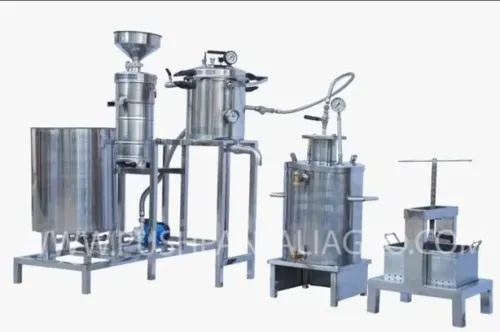
 | SS Soya Milk Plant 180 LPH (Upgradable Model ₹240000 Soya Milk and Tofu (Soya Paneer) Making Plant, a multi-stage industrial food processing system designed to produce plant-based milk and solidified... View product → |
Keywords