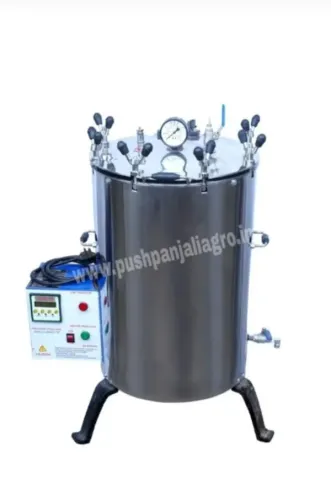
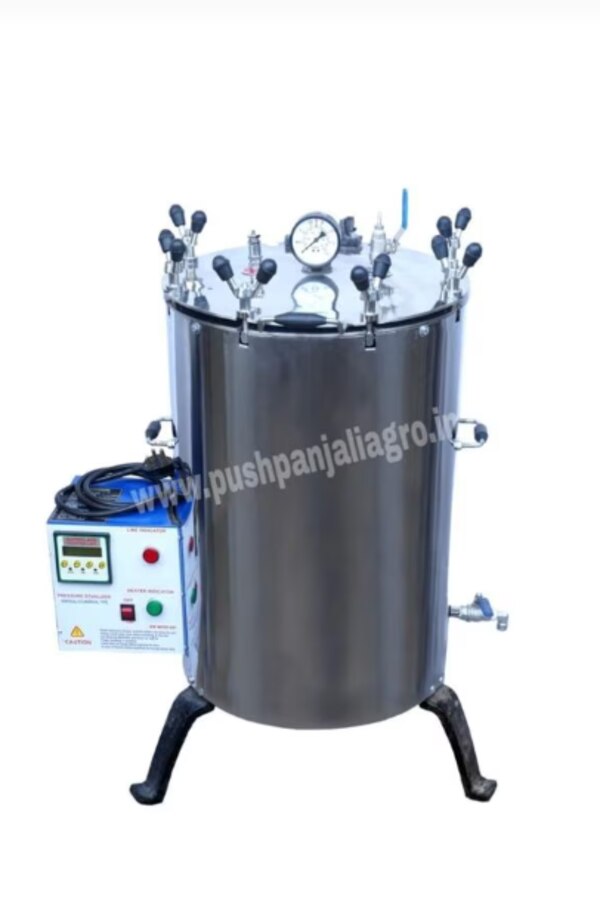
A request for a replacement cap is incomplete until you establish which removable part has failed: the pressure-vessel lid, gasket, locking hardware, valve cap, or bottle-retaining cover. By checking the machine identity, dimensions, pressure components and fault symptoms in the right order, you can avoid fitting an unsafe or incompatible part and obtain a service quotation that addresses the whole sterilizer.
Key takeaways
- Name the exact cap part before requesting an 80-litre sterilizer replacement.
- Inspect the lid, gasket, clamps, valves and vessel before blaming the cap.
- Match pressure rating, material, dimensions and food-contact suitability before fitting.
- Require testing, leak checks and commissioning records before production use.
What does “cap” mean on an 80-litre glass bottle sterilizer?
“Cap” can mean six different parts, so do not request a glass bottle sterilizer cap in Ambala by litre rating alone. It may be the pressure-vessel lid, the lid gasket, a clamp or locking bolt, a valve cap, a bottle-retaining cover, or an individual bottle closure.
A gasket seals the lid; it is not the lid itself.
“80 litre” normally describes nominal chamber or tank volume, not bottle capacity. Usable loading depends on basket dimensions, bottle diameter and height, clearance around bottles, and whether the machine uses a rack or loose loading.
Record these details before requesting a quotation:
- Photograph the complete sterilizer, lid underside, locking mechanism, nameplate, flange and damaged area.
- Copy the manufacturer, model number, serial number, chamber diameter and lid diameter from the machine.
- Measure bolt count, bolt-circle diameter, hinge or clamp arrangement, thread size and gasket cross-section.
- Note the steam and drain-port positions, then state whether the lid, gasket, locking hardware or valve cap is damaged.
- Request a parts drawing or dimensional sketch before ordering.
A matching outside diameter does not prove compatibility. Flange width, bolt pattern, gasket groove and port locations can differ, making an apparently similar replacement unsafe or impossible to seal. Include the gasket in the specification if it is hardened, flattened, cut, swollen or permanently compressed.
How do you inspect the sterilizer and separate a cap fault from another failure?
A cap leak does not prove that the cap is the failed part. Use this sequence before dismantling the sterilizer or ordering a glass bottle sterilizer replacement cap in Ambala.
1. Isolate steam, electricity and every other energy source. Allow the chamber to cool fully, confirm zero pressure on the gauge, then close or lock the steam supply and drain connections according to the manufacturer’s procedure. Do not loosen clamps or bolts while pressure or heat remains.
2. Record the symptoms before removing anything. Note where water or steam escapes, whether the pressure gauge rises and falls normally, what the temperature display shows, which valves operate, and whether the cycle stops, overheats or fails to reach pressure.
3. Inspect the threads, hinge, clamps, locking bolts, bolt holes, flange, gasket groove and sealing faces. Check the gasket for hardening, flattening, cuts, swelling and permanent compression. A new lid with an old failed gasket can still leak.
4. Reject a distorted pressure boundary rather than correcting it with extra tightening or grinding. Look for a warped flange, dents beside clamps, elongated bolt holes, cracked welds, corrosion and uneven contact around the seal. These faults point to a lid, vessel or locking-hardware repair.
A leak at the sealing face suggests a gasket or lid problem; a leak at a valve suggests valve failure. An inaccurate gauge, faulty safety valve, failed interlock or damaged vessel requires broader repair, not a cap-only order. Do not operate the sterilizer until a competent technician confirms the cause.
Which safety and material checks decide whether a replacement cap is suitable?
An 80-litre lid is not interchangeable across brands or capacities. Match the cap to the vessel, not its nominal volume. A lid for open hot-water service is unsuitable for pressurised steam unless its pressure boundary, locking system and relief arrangement are rated for that service.
Check these dimensions and operating limits against the nameplate and parts drawing:
| Item | What to compare | Why it matters |
|---|---|---|
| Working conditions | Vessel working pressure, design pressure and steam temperature | A matching outside diameter does not prove pressure safety |
| Protection | Safety-valve setting, relief arrangement and inspection requirements | A wrong lid can defeat overpressure protection |
| Fit | Flange width, gasket-groove dimensions, bolt count and bolt-circle diameter | Poor seating causes leaks or uneven gasket compression |
| Hardware | Clamp geometry, hinge arrangement and locking components | Forced closure can distort the lid or leave an unsafe lock |
| Connections | Steam, drain and instrument-port locations | Misplaced ports prevent correct assembly and operation |
Do not drill or weld a new port into an existing lid; that changes the pressure boundary. For 80 litre bottle sterilizer parts in Ambala, request the exposed stainless-steel grade, corrosion resistance, machining tolerances and evidence of compatibility with repeated heating, cooling and cleaning.
Specify gasket compound and dimensions: silicone, EPDM and fluorocarbon elastomers resist heat, oils, milk residues and cleaning chemicals differently. “Food-grade rubber” is not enough.
Confirm whether the quote includes the gasket, clamps, bolts and valve components. If the fault suggests a wider problem, inspect the pressure gauge, safety valve, temperature sensor, heater, thermostat or controller, drain valve and bottle basket too.
How should you verify and commission the replacement before production use?
Accept the replacement only after dimensional, mechanical, safety and process checks confirm that it matches the sterilizer, not merely that it resembles the old lid.
1. Compare the supplied cap with the approved drawing and recorded measurements. Check the material grade, surface finish, threads, flange flatness, bolt holes, gasket-groove dimensions and welds. Reject distortion, cracks, sharp damage, incomplete welds or holes that do not align.
2. Perform a dry fit with no pressure. The lid must seat evenly, the gasket must compress consistently, and each clamp, bolt and locking component must move smoothly without forcing or cross-threading. Confirm that the pressure gauge, safety valve and lid interlock occupy their specified positions.
3. Follow the vessel manufacturer’s instructions and local safety rules for leak testing, pressure testing and qualified commissioning at the rated pressure. An improvised steam test alone does not prove safe operation.
4. Have a competent technician check temperature with a calibrated instrument at representative load locations. Confirm that the timer starts at the defined process temperature, then verify air removal and steam contact where steam sterilisation is used.
5. Run a controlled trial using the intended basket and bottle arrangement. Check bottle clearance, gradual heating and controlled cooling; overloading, trapped air, hot-to-cold contact and thermal shock can cause uneven treatment or cracked glass even when the display shows the correct temperature. Record the results before releasing the sterilizer for production.
What should a repair and parts quotation in Ambala include?
A credible glass bottle sterilizer service in Ambala quotation separates safety checks from a quick thermostat replacement or lid tightening.
| Service item | Quotation should state | Why it matters |
|---|---|---|
| Inspection | Fault symptom, machine condition and findings | Identifies the actual failure |
| Descaling | Scale on immersion heater and cleaning method | Scale slows heating, reduces heat transfer and causes local overheating |
| Electrical testing | Heater, thermostat, controller, wiring and insulation checks | A replacement thermostat does not prove electrical safety |
| Gasket replacement | Material, cross-section and dimensions | The wrong gasket can leak or deform |
| Lid or cap replacement | Part dimensions, flange and seating details | “80 litre” does not identify a compatible lid |
| Locking-hardware repair | Clamp, hinge, bolt and thread work | Forced locking can damage the pressure boundary |
| Leak testing | Test method, pressure and result | Tightening a lid is not a leak test |
| Gauge or sensor calibration | Instrument tested against a reference | A false reading can invalidate the cycle |
| Pressure-vessel examination | Vessel, welds, flange and corrosion findings | A damaged chamber needs broader repair |
| Commissioning | Load, temperature, pressure and operating checks | Confirms safe production use |
The quotation must name the make, model, serial number, chamber dimensions, working pressure and temperature, supplied parts, testing method and exclusions. Request photographs plus a dimensional sketch or parts drawing when no manufacturer part number exists.
For 80 litre bottle sterilizer parts in Ambala, require descaling chemistry compatible with the vessel, heater sheath, gasket and drain components. Pushpanjali Industries is worth comparing with other suppliers when it documents these checks and distinguishes a cap order from pressure-vessel repair.
Related product
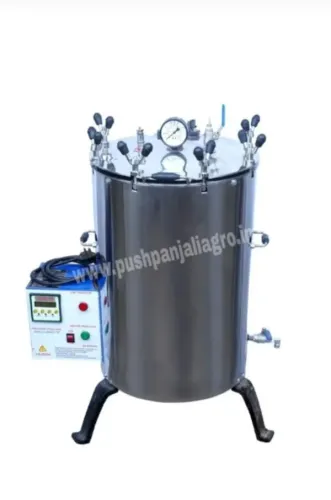
 | Glass Bottle Sterilizer (cap. 80 lts.) Pushpanjali Agro Vertical Autoclave, a high-pressure steam sterilizer commonly used in food processing, laboratories, and medical facilities to kill... View product → |
Frequently asked questions
What does “cap” mean on an 80-litre glass bottle sterilizer?
It can mean the pressure-vessel lid, lid gasket, clamp or locking bolt, valve cap, bottle-retaining cover or an individual bottle closure. Give the supplier the exact part name, dimensions and photographs.
How do you separate a cap fault from another sterilizer failure?
Inspect the lid seating surface, gasket, clamps, locking hardware, valves, gauges, heater and vessel for damage or leaks. A failed seal does not prove that the lid itself needs replacement.
Which checks decide whether a replacement cap is suitable?
Compare the replacement with the sterilizer’s dimensions, pressure and temperature requirements, material grade, food-contact suitability, gasket material and locking arrangement. Do not fit a part based on litre capacity alone.
What should a repair and parts quotation in Ambala include?
Request the exact part description, dimensions, material, quantity, labour, travel, testing, installation, taxes, delivery time, warranty and commissioning scope. Ask whether the quotation covers the gasket and fasteners.
Keywords