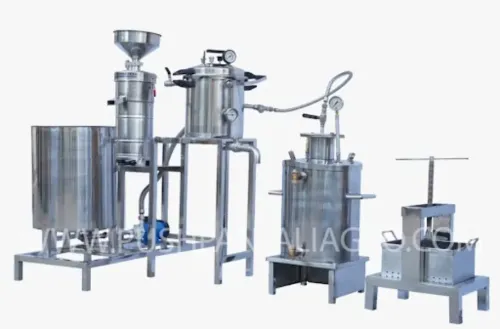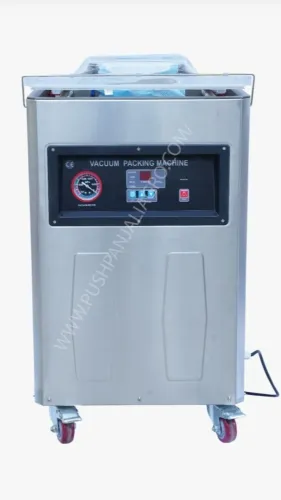
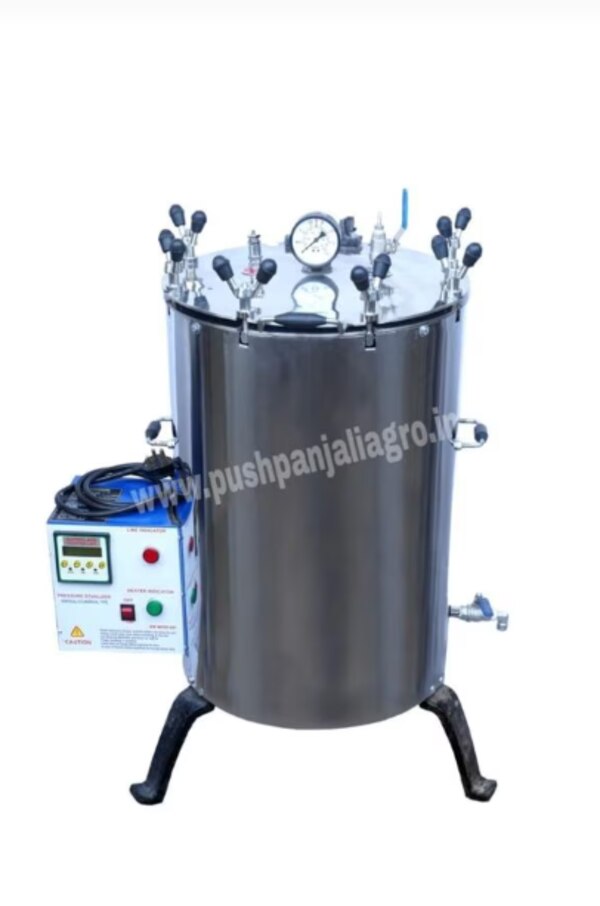
An 80-litre rating does not tell you how many 250 ml, 500 ml, 750 ml or 1-litre bottles will fit, how long one complete batch will take, or whether your caps and filled products can tolerate the process. By checking the usable basket capacity, validated temperature and pressure settings, retailer throughput, installation demands and installed cost, you can decide whether the machine earns its space and electricity at your operation.
Key takeaways
- Treat 80 litres as chamber volume, not guaranteed bottle capacity.
- Ask for usable basket dimensions and a bottle-count trial before ordering.
- Keep bottles, closures and filled products on separate validated cycles.
- Compare cycle time, power load, controls, warranty and installation in the quotation.
How many bottles fit in an 80-litre sterilizer?
An 80-litre label describes the chamber or water-tank volume, not bottle capacity. An 80 litre glass bottle sterilizer in Ambala may hold very different quantities of 250 ml, 500 ml, 750 ml or 1-litre bottles, depending on usable internal space and basket design.
Ask the supplier for:
- Usable internal chamber dimensions, excluding heaters, pipes and fittings.
- Rack or basket dimensions and the stated count for your exact bottle.
- Allowable bottle diameter, height, neck clearance and spacing between glass surfaces.
- Basket spacing for 250 ml, 500 ml, 750 ml and 1-litre formats.
Load empty or pre-rinsed bottles upright in a rack or basket. Leave space between bottles so heat and water reach their surfaces, and keep each neck clear. Put caps, liners and other closures in a separate perforated tray rather than balancing them on bottle mouths.
- Wash bottles before sterilization. Milk, soya residue, fat, protein and sugar can shield microorganisms from heat; sterilization does not remove this soil.
- Reject every bottle with a chip, crack or deep scratch. Damaged glass can fail during heating or handling.
- Confirm the supplier’s count using your actual bottle, rack and closure tray. A bottle sterilizer for food retailers is useful only when its stated count matches your loading pattern, not when the calculation relies on the 80-litre label.
What does one safe sterilization cycle involve?
Fill the reservoir with the specified water, then load washed bottles and compatible closures. Keep bottles upright, use the rack or basket, and leave glass surfaces apart. Close and lock the lid before selecting the validated cycle.
- Monitor temperature and pressure throughout heating and exposure.
- Wait until pressure reaches zero before opening the lid.
- Remove bottles with heat-resistant tools and cool them in a controlled way.
An 80 litre glass bottle sterilizer in Ambala is not supplied with a universal recipe. Do not choose settings from the 80-litre label. Ask the supplier for a cycle based on the coldest load location, exposure time, load pattern and air removal, including the required temperature and pressure.
| Treatment | What it proves | What it does not prove |
|---|---|---|
| Boiling at atmospheric pressure | Sanitation or microbial reduction | Validated commercial sterility |
| Scheduled pressure process | Defined lethality at the coldest location | Shelf stability without product validation |
Boiling bottles in hot water is not automatically commercial sterility; air pockets, bottle position and exposure time change the delivered lethality.
Preheat glass gradually and cool it under control. Do not pour cold water onto hot glass or place hot bottles on a cold metal surface. Reject chipped or scratched bottles.
Caps, liners, induction seals and elastomeric gaskets need their own maximum-temperature limit. Require post-cycle leak checks and torque checks, because glass-safe heat can deform closures or reduce sealing force.
Can you sterilize bottles, closures and filled products in the same unit?
No. Sterilize an empty bottle before filling it; process a sealed, filled bottle with a separate validated thermal schedule. Pressure, product pH, fill temperature, closure integrity and spoilage risk all change after filling, so a bottle sterilizer for food retailers does not automatically make juice, dairy, soya milk or another product shelf-stable.
Low-acid foods require a scheduled process, not a machine purchase alone.
- Load washed glass bottles, empty or pre-rinsed, in a rack or basket with space between glass surfaces. Keep the necks clear and place caps or closures in a separate perforated tray.
- Add only caps, closures and utensils whose materials have documented temperature compatibility. A glass-safe temperature can deform plastic, heat-sensitive liners, induction seals or elastomeric gaskets, causing leaks, odour or lost sealing force.
- Keep incompatible plastics, electronic parts, chemicals and sealed containers outside the chamber unless the manufacturer explicitly validates them for that cycle.
- Treat washing as a separate step. Milk, soya residue, fat, protein and sugar can shield microorganisms from heat, so sterilization cannot replace effective washing and rinsing.
Record each run to support FSSAI hygiene controls and a documented food-safety management system: batch ID, start time, end time, achieved temperature, exposure time, operator and every deviation. For filled products, obtain process-authority validation and check closure leaks or torque after processing; do not infer shelf life from the sterilizer’s temperature display.
Will the batch size meet a retailer’s daily demand?
Count complete cycles, not litres. For an 80-litre bottle sterilizer for food retailers, calculate: actual bottles per cycle × usable cycles per shift. A cycle includes loading, heating, exposure, pressure release, cooling, unloading, draining, drying and sanitation; manual handling and recovery time can reduce output sharply.
1. Record the real time for each stage using your washed bottle, rack and closure load. Do not count bottles that cannot be removed safely or leave no space for circulation.
2. Use energy as a reality check. Heating 80 litres from 20°C to 95°C needs about 7.0 kWh before losses. A 6 kW heater has an ideal heating time near 70 minutes; a 9 kW heater is near 47 minutes. Tank, lid, piping and evaporation losses make actual heating longer.
3. Multiply the bottle count by the cycles that fit after breaks, cleaning and shift change. Compare that number with daily demand, not the chamber label.
This suits juice shops, dairy retailers, cafés and small beverage bottlers with regular reusable-bottle demand, existing washing and drainage, trained staff and documented batches. Intermittent demand or disposable bottles can make labour, electricity, downtime and validation cost more than the saving.
Before buying in Ambala, check heater rating, phase, current, dedicated circuit, earthing, water hardness, descaling access, drain, tank grade, weld finish, gasket material and a cleanable rack design. Ask for a cycle demonstration and actual bottle count.
What should you compare before accepting an Ambala quotation?
“commercial glass bottle sterilizer price in Ambala” has no useful single figure until the quotation defines what you receive. An “80 litre glass bottle sterilizer in Ambala” could have very different usable capacity, electrical demand and commissioning support.
| Item | Require in the quotation |
|---|---|
| Chamber and basket | Internal chamber and basket dimensions, bottle count for your bottle, and allowable diameter, height and neck clearance |
| Heating and controls | Heater wattage, supply and phase, controller, temperature recorder and pressure gauge |
| Loading parts | Racks, bottle spacing and a separate perforated closure tray |
| Delivered cost | Installation, freight, GST, commissioning, warranty and after-sales service listed separately |
Ask for a live demonstration, or a written cycle record using your bottle, cap and actual load pattern. The record must show achieved temperature, holding time, cooling method and pressure-release procedure. A catalogue label is not process validation.
Require the maximum validated cap temperature, bottle thermal-shock guidance, water-quality requirement and descaling instructions. Confirm who supplies the dedicated circuit, earthing, drain connection and operator training.
Pushpanjali Industries is a supplier you can approach for a specification-led discussion, but base the decision on documented capacity, commissioning and service rather than the catalogue name.
Buy when reusable-bottle demand is regular and the supplier proves the process. Choose washing plus outsourced or alternative packaging when demand is low, or the quote omits validation and installed requirements.
Related product
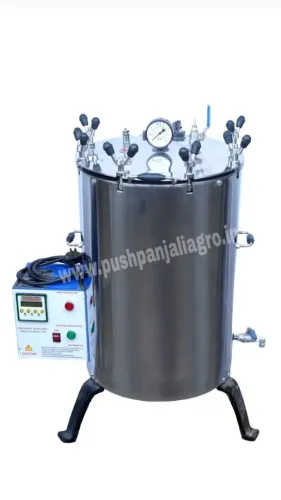
 | Glass Bottle Sterilizer (cap. 80 lts.) Pushpanjali Agro Vertical Autoclave, a high-pressure steam sterilizer commonly used in food processing, laboratories, and medical facilities to kill... View product → |
Frequently asked questions
How many bottles fit in an 80-litre sterilizer?
The count depends on usable chamber space, basket dimensions, bottle shape and clearance. Request the internal dimensions and a trial count for your exact 250 ml, 500 ml, 750 ml or 1-litre bottles.
What does one safe sterilization cycle involve?
A safe cycle requires cleaning, correct loading, controlled heating, the specified holding time, cooling and hygienic unloading. Ask the supplier for the temperature, holding time, monitoring method and operating procedure.
Can bottles, closures and filled products be sterilized in the same unit?
The same unit may handle them only when its chamber, baskets, controls and process are suitable for each load. Do not assume that an empty-bottle cycle is safe for closures or filled products; request separate validated settings.
Will the batch size meet a retailer’s daily demand?
Calculate output from bottles per cycle, heating and cooling time, unloading and cleaning time, and the number of shifts. Compare that practical output with the retailer’s daily requirement rather than using the 80-litre label.
What should you compare before accepting an Ambala quotation?
Compare usable basket capacity, cycle duration, temperature controls, power or fuel load, material grade, safety features, warranty, installation, operator training, spare parts and taxes or delivery charges.
Keywords